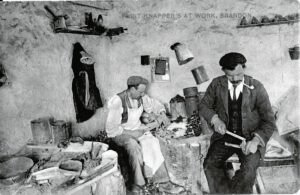
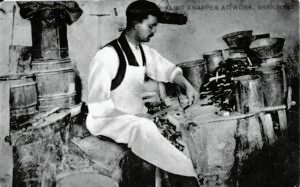
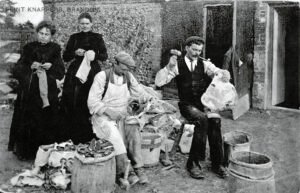
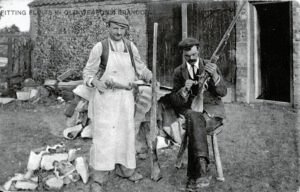
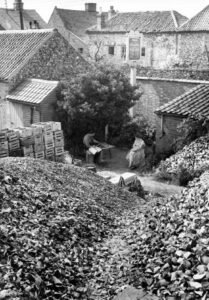
Brandon became the most prominent centre for gunflint production due to the superior quality of its local black flint. At its peak during the Napoleonic wars, local Flintknappers were supplying over one million musket flints per month in 1813. These best quality black flints were prized for their reliability, with a single flint lasting up to 50 shots.
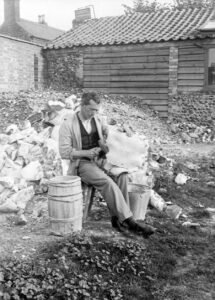
According to S.B.J. Skertchly (an expert in this field), a typical flintknapper worked a 12-hour day and produced an average of up to 3,000 gunflints. A good one might do 4,000. They typically worked a 4 day week from Wednesday to Saturday. The constant inhalation of flint dust meant that they would likely contract a lung disease like silicosis and die young.
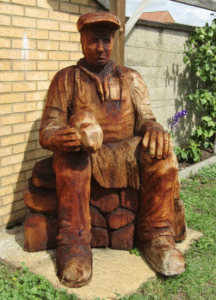
The demand for gunflints declined dramatically after 1835 when percussion cap rifles were invented. Brandon continued to supply flints for export, particularly to Africa, well into the 20th century. The last of Brandon’s traditional gunflint knappers, Fred Avery, retired in 1980 and died in 1996, marking the end of the town’s historic flintknapping industry. There is a wooden sculpture of Fred in the centre of the town to remind visitors of this historic period.
Today, Flint mining and the remnants of the Flintknapping trade can still be seen in and around Brandon. There is a Visitors Centre just outside of town where one can explore the ancient Grime’s Graves mines to see the prehistoric origins of the craft. The Brandon Heritage Centre and Ancient House Museum in nearby Thetford showcase the history of flintknapping. The former gunflint workshops behind the Flintknappers Arms pub are a reminder of the industry.
Flint is also used as a building material, and when it is knapped or ‘finished’ to produce a flatish, shiny black surface, it may be used to produce a fine decorative pattern on outside walls. To see some of the buildings in the town which have been built using this technique, please visit the following web pages: –
Bliss Mausoleum St Peter’s Church Railway Station
To find out more about Brandon Flint and the part it played in winning the Battle of Waterloo in 1815 please visit this web page: – Battle of Waterloo 210th Anniversary